Unknown's avatar

About oxhilldevons

My family and I operate a small farm raising American Milking Devon cattle, training oxen, making ox equipment and living the country life.

PACKER’S PATENT STUMP PULLER AND WALL BUILDER

The following advertisement is from American Agriculturist, Volume 25, 1866

PACKER’S PATENT STUMP PULLER AND WALL BUILDER

This Machine differs from all other machines for these purposes in its convenience for transporting Stumps, Stones, Cannon, Shafts, Castings, or any heavy weights. After having lifted them with its immense purchase, and strongly trussed frame. The combination of the arched reach with the truss, gives ample room for the load, while the wheel may be of common size. The load being on 4 wheels, is easy on the team, and the machine may be worked by either oxen or horses. The superiority of this Machine as a wall builder, makes It deserving of especial notice. The stone, after being lifted out of the ground, can be drawn alongside the wall to the end and the machine turned so as to bring the load directly across the wall in which position the heaviest stone can be deposited with ease, either at the bottom or top of the wall, and the machine may then be turned back, leaving the stone in place. For particulars, Address PACKER & FISH, Mystic River, Conn. 

This article appeared in the same publication.

Wall Builder and Stump Puller. Mr. Packer, of Mystic Conn., in working among the rocks of New London County found the necessity for a machine to lift heavy rocks transport them and deposit them in walls or wherever needed. So he invented one with a pair of shears on strong wheels held apart by two powerful curved reaches giving room for a stone to be swung high between them. For a wall layer, when large stones, say from 1 to 10 tons are to be moved, it is doubtless an excellent thing and has done first rate work in New London County. As a stump puller, it must demonstrate its own excellence. 

After finding the advertisement and article above I was hooked and did a little research and found that it was developed and patented in 1865 by George Washington Packer of Connecticut.  I have not been able to find the patent information but I did find the image below, at connecticuthistory.org, of the device being demonstrated.

Note the huge boulder lifted out of the ground.

Finally, I found that just last October the Mystic River Historical Society posted  an article by Lou Allyn siting a pamphlet  with a description of the devices use.  According to the article the author and date of the pamphlet are unknown but I think it gives a great insight to its use and a bit of the times.  An excerpt from the pamphlet is below.

It may be mentioned here, that the land in this vicinity and for miles in all directions is covered with boulders – boulders large and boulders small, sometimes ledges, but boulders in all shapes, boulders in all positions, boulders on boulders—everywhere. The first settlers simply removed or cleared the smaller rocks, such as a horse could easily drag out of the way, leaving hundreds of heavier ones half embedded in the soil in all directions. Thus thousands upon thousands of acres of splendid soil have been fit for naught but cattle runs of natural pasturage. To clear such land of everything to obstruct the free running of a plow, is a herculean task and it is this wrestling with the stern face of nature, that I found to be the delight of my host. A forenoon spent in watching and assisting in the operations, found me deeply interested. A device called a “Stone-puller” was quite fetching, and was the invention of a near-by resident whom I was disappointed to learn had never realized much out of it, for without it, such operations as are here going forward,
would be prohibited by the question of cost. Mr. H— has 428 acres of just such land as described; skirting the shores of L. I. Sound with deep coves running up on either side of his property; forming between them, Long Point, which is all included in the Haley Farm,
with the exception of a tract on the extreme point, which is owned by parties who started to boom it for Summer cottage purposes, but came to a dead-lock with the town authorities regarding approaches, and who should bear their cost. A description of the boulder-wall building may be interesting. A lot having been chosen for clearance, and direction of proposed walls staked out, all rocks within its area, are first drilled to admit the hooks of
the hoisting apparatus. This work is done in Winter by Messrs. Latham and Slater, two neighbors employed by Mr. H—, who also run the stone-puller. The cost of drilling last
Winter was $72. In the Spring, frost being out and ground settled, the stone-puller (drawn by an immense pair of oxen raised on the place) and looking like the semi-circular truss of a bridge over a country creek—on wheels, proceeds to lift every stone out of its bed by means of time hoisting tackle, which hangs from the centre of the truss just mentioned, behind, being a winch, to winch the rope is led for hoisting. Every stone is dropped alongside the hole it came out of, awaiting its turn to be selected when the work of
building the wall commences in earnest. Sometimes a rock proves to be larger  underground than it appeared on the surface and proves too heavy for removal. In
this case, blasting is resorted to; powder being used in preference to dynamite, as not being liable to splinter, but merely to crack the stone under treatment. These preparatory arrangements being complete, the line of the proposed wall is trenched 3 feet deep and 4 feet wide, the soil so excavated being utilized to fill in the great gaping holes in the ground from which the boulders have been hoisted. The trench is then filled in with smaller rocks and broken pieces, and large ones, for that matter, so, however, that they do not come above the level of the ground; thus forming a good foundation and drain at the same time. Fine stone is laid over all, causing the site of the proposed wall to appear like a newly
macadamized road, and easy for the oxen to walk over, which they have to do with every stone laid. The stone-puller is now again brought into use and the foreman of the work selects the first rock, which is hoisted just clear of the ground and hauled to the commencement of the wall, where it is deposited on the prepared foundation. This is called a “bottom,” and the “bottoms” are usually from 1 to 3 tons each. When a second bottom has been laid, the stone-puller fetches lighter stones, from 1/2 ton to 2 tons each, for the top of wall. The machine is laid at right-angles to the wall, the stone hoisted as high as the pulley admits, the oxen swerved in a couple of steps, and the stone swings into its position and is lowered to its bearings more handily, and with less fuss and talk, than I have ever seen anything of the same weight moved and placed before. I found that my host was quite at home in directing a gang of men and a past grand in the art of boulder-wall construction. The “bottoms” are always a couple in advance of the top part and no
more, all through otherwise the work of getting on the heavy top stones would be up-hill indeed. Hands follow the stone-puller to chock the wall before the great stones settle, that is, to fill tip all crevices, great or small, with suitable stones. Quite considerable judgment and forethought are requisite in the selection and placing of the rocks, both in building and chocking, to make a neat piece of work. 

I hope you found this as interesting as I did!

Cattle for Western Pennsylvania

Taken from The American Agriculturist, Volume 32, 1873

“E.C.J.”., Clinton, Pa. asks which is the best breed cattle for Western Pennsylvania, Durham, or Devon. Devon, by all means; Durham cattle would be much out of place on hilly ground or on thin pastures, while the Devons are at home in such a country. 


“Old Partner”

This video is almost an hour and twenty minutes long and is in Korean with no subtitles.  I honestly couldn’t imagine watching it in its entirety so I started skimming it.  I ended up hooked and had to start it over to watch it all from the beginning.  I guarantee you will get more from it than whatever is on television tonight!  This is a wonderful documentary about a Korean couple, Mr. Choi Won-Kyun, his wife Lee Sam-Soon, and their faithful cow that they use to farm with in the mountains of Korea.  The couple are in their eighties and the cow is forty years old!  No that is not a typo.  She is forty years old!   Yes it is interesting as an ox enthusiast to see their cattle and equipment and to watch their methods but this is much bigger than that.   “Perseverance” keeps popping into my head as I watch it.  If you enjoy it, and I’m sure you will, then you can get the DVD which includes English subtitles.

Milking Devons: Are they cattle or are they goats?

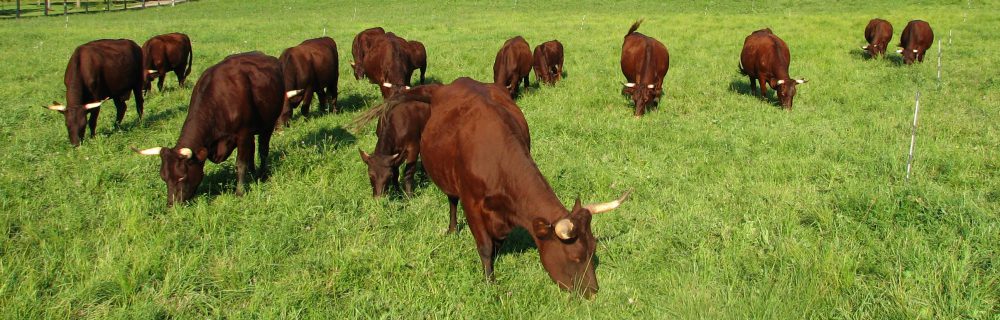
The Pennsylivania deer season ended Saturday so on Sunday we opened the pasture up to give the girls some fresh pasture, outside of the safety zone provided by the house and barn.  We also put a bale of haylage in the feeder.  This was the first bale of haylage we have used.  It smells like candy and the sweet odor carries for hundreds of yards.  Forgetful me neglected to turn the electric fence back on until I realized it at about nine o’clock at night.  This morning I went to bring the girls in for a bit of grain as I do every morning and I was surprised to find just one lonely heifer waiting at the door.  She bawled for her mates but none answered.  I thought for sure the rest had gotten out and relocated to another county.  I set out into the dark and rain to inspect the fence figuring I could find the break now and start tracking them as soon a some daylight came.  Of course while I was doing this I congratulated myself for not remembering to turn the fence on!  Eventually  I started to make out their dark shapes ahead.  Thankfully they never had gotten out  but they did mass in the corner of the pasture as far from the barn as they could get.  Why?  They where enjoying some spruce branches I had pruned a week ago.  I knew they liked to pick at low hanging spruce branches, and will even eat multiflora rose, when it is in the correct stage of growth, but it surprised me that despite having fresh pasture, a fresh bale of candy haylage and a standing appointment for a dish of grain they preferred to eat trees.  I guess that’s why they are so thrifty!

Outlook: Bullocky

In Australia, an ox is referred to as a “bullock” and a teamster is referred to as a “bullocky”.  The use of large spans of bullocks was common much later than here in the U.S. and the few remaining “bullockies” still work them this way, very similar to the old “bullwhackers” of the U.S..

Here is a fantastic video of one such bullocky from 1969.  It was made by The Commonwealth Film Unit and directed by Richard Mitchell.  As I watch, it is interesting to note the similarities and differences with our cattle, equipment and methods here today.  I imagine that man was every bit as tough as the thick greenhide plaited whip he is cracking!

“Vic Deaves is a fourth-generation bushman. For as long as he can remember, his family has lived off the land, often as timber-getters in the coastal valleys of New South Wales. Vic is a bullocky, one of the last of his kind. With his team of bullocks he drags logs out of the valley too choked and precipitous for mechanised transport. It’s a way of life that is dying and part of Australian history will die with it.”

Book Overview: In Praise of Oxen

My original intent in doing book overviews was to try to help people be more confident in their ox related book buying decisions by giving a brief description and to categorize the book as either a practical guide or more of a history book.  Well this book has a lot of history in it but it isn’t a history book full of dates and time lines.  If you try, you could glean some practical advice from it but I wouldn’t call it a practical guide.  I don’t know how to categorize it other than to call it just plain beautiful!  It has just over one hundred pages and all but a handful contain at least one beautiful picture of fine Nova Scotia head yoked oxen and many contain several.  Most of the pictures, taken by Terry James, are accompanied by quotes taken from interviews with various teamsters.  The quotes make you feel like your eavesdropping on a couple of old teamsters regaling each other about their teams of yesterday and how it was in their heyday   The book could easily stand on its own with just the fantastic pictures, and insightful quotes but it does include some text, written by Frances Anderson, colorfully explaining the history and culture of oxen and their teamsters in Nova Scotia.  The book is broken up into acknowledgments, preface, introduction, and just three chapters including “EVERYBODY HAD OXEN”, “THEM TIMES, THE CATTLE WAS WORKED”, and “THE CATTLE DO DRAW A CROWD”.  This book is like no other.  It won’t help you with any training problems and it won’t fill you with bunch of historical facts to expand your ox knowledge but it will certainly entertain you and will likely inspire you!

Singing the praises of the Devon ox!

The following is taken from Cattle: Their Breeds, Management, and Diseases, By William Youatt, 1834

There is a peculiarity in driving the ox team, which is very pleasing to the stranger, and the remembrance of which, connected with his early days, the native does not soon lose. A man and a boy attend each team; the boy chants that which can scarcely be regarded as any distinct tune, but which is a very pleasing succession of sounds, resembling the countertenor in the service of the cathedral. He sings away with unwearied lungs, as he trudges along almost from morning to night, while every now and then the ploughman, as he directs the movement of the team, puts in his lower notes, but in perfect concord. When the traveler stops in one of the Devonshire valleys, and hears this simple music from the drivers of the ploughs on the slope of the hill on either side, he experiences a pleasure which this operation of husbandry could scarcely be supposed to be capable of affording. This chanting is said to animate the oxen somewhat in the same way as the musical bells that are so prevalent in the same county. Certainly the oxen move along with an agility that would be scarcely expected from cattle; and the team may be watched a long while without one harsh word being heard, or the goad or the whip applied. The opponents of ox husbandry should visit the valleys of north or south Devon, to see what this animal is capable of performing, and how he performs it.

Breaking down while trucking livestock!

Today we were on our way to a show with six head of cattle when the fitting at the bottom of the radiator completely separated. It instantly drained the radiator and overheated the engine dashing any chance of making it to the show.

Missing the show and the truck repairs will prove quite costly and yet in hindsight I feel very lucky!

We were not terribly far from home and I was able to call a buddy to haul the trailer and cattle home. It was a nice cool morning and the wait was reasonable so the cattle could safely and comfortably stay on the trailer. AAA quickly towed the truck to the garage of my choice. (A worth while service by the way.) Everyone made it home safe and I don’t think my daughter even picked up any new vulgar vocabulary! So in hindsight I believe things could have been much worse!

As we sorted things out and waited for help I couldn’t help but wounder what if…. What if we where out of our home territory? How are you going to find some one to help with a trailer full of livestock? How long would it take? On a hot day how long can you let the livestock bake in a hot trailer and what could you do about it? The older heifers where tied and we had four small calves loose in the trailer but I did have a halter and rope for each one. All the cattle were either able to be driven or lead so if I had really had to I could have unloaded them and tied them to nearby trees. However, we have traveled many miles of highway where this would not have been possible. The truck won’t be fixed for three days. Since the cattle are happy as clams in their home pasture that is no big deal but if this had happened several hundred miles from home or friends it would be a very different story.

So how does one best prepare for such things? Obviously having well maintained equipment would be number one, but life happens! I have found a cell phone to be worth its weight in gold. I had a little peace of mind in that we did have a rope and halter for everyone if absolutely necessary and that I had a bit of cash in my pocket. The only other thing I can think of is to hit the dirt and pray for a kind stranger to come to the rescue.  We did have one person kindly stop and offer help but I hate to be at the mercy of strangers or happenstance.

So what do you do to prepare for such a situation?