Unknown's avatar

About oxhilldevons

My family and I operate a small farm raising American Milking Devon cattle, training oxen, making ox equipment and living the country life.

THE LITTLE BROWN BULLS

Not a thing in the woods had McCluskey to fear,
As he swung the gord stick o’er his big spotted steers,
Short leg-ged and shaggy, girting eight foot and three,
Said McCluskey to Scot, “They’re the laddies for me.”

Oh, next came Bull Gordon, the skidding was full
As he hollered “Whoa hush” to his little brown bulls,
They were young, sound, and quick, girting six foot and nine,
“Too light,” said McCluskey, “to handle our pine.”

“For it’s three to the thousand, our contract did call;
Our skidding ‘tis good and our timber, ‘tis tall.
Said McCluskey to Gordon, “To make the day full
I will skid ten to one of your little brown bulls.”

“Oh no,” said Bull Gordon, “that you never can do,
Though your big spotted steers are the pets of the crew,
But mind you, my laddie, you’ll have your hands full
When you skid one more log than my little brown bulls.”

Oh, the day was appointed, and soon it drew nigh,
For twenty-five dollars their fortunes to try.
Both eager and anxious, the morning was found;
The scalers and judges appeared on the ground.

That morning said Gordon, with blood in his eye,
“Today I will conquer McCluskey or die.”
Said Sandy to Gordon, “We’ll take off their skins;
We’ll dig them a grave, we will tumble them in.

With a whoop and a yell came McCluskey in view,
With the big spotted steers, the pets of the crew,
Sayin’, “Chew your cuds slowly, boys, keep your mouths full,
For you eas’ly can conquer those little brown bulls.”

Oh, next came Bull Gordon, with the little brown bulls,
With a pipe in his mouth and a cud in his jaw,
But little did they think when they saw them come down
That a hundred and forty they could eas’ly yank ‘round.

Oh, the sun had gone down and the foreman did say,
“Turn in boys, turn in, you’ve done enough for today,
For well we have called each man for his team;
Very well do we know which team holds the beam.”

After supper was over, McCluskey appeared,
With a belt ready made for his big spotted steers.
To make it he tore up his best mackinaw;
He was bound to conduct it according to law.

Oh, the scaler speaks up; said he, “Hold on you a-while,
Your big spotted steers are behind just a mile.
You’ve skidded one hundred and ten and no more,
While Gordon has beat you by ten and a score.”

The boys, they all holler’d; McCluskey did swear,
As he tore out in handfuls his long yellow hair.
Said McCluskey to Gordon, “My dollars you’ll pull,
And the belt you shall have for your little brown bulls.”

So here’s to Bull Gordon and Big Sandy John,
For the biggest day’s work on the Wolf River ever was done.
So fill up your glasses, boys, fill them plumb full,
And we’ll drink to the health of those little brown bulls.

Collins Draft Horse, Ox and Pony Club’s 30th annual Plow Fest

Last Sunday we took the girls out in public for the first time.  We attended the Collins Draft Horse, Ox and Pony Club’s 30th annual Plow Fest.  It made a great place to introduce them to crowds.  It is a laid back event with plenty of area to maneuver and get away if need be.  I cringed as we pulled up and saw that the field was covered in rye grass nearly up to my knee.   The girls are very good about not grazing while working at home and so it hasn’t been covered much but this was too much to ask.  They did get a few bites in but not nearly as bad as I anticipated and they did start to respond to the “head up” command.  I got a chance to introduce them to the furrow and, while far from perfect, I think they did pretty well.  As always we had a lot of fun talking to people about oxen.

There is more to see and do at the plow fest than just watch plowing.  My whole family including my almost two year old had a good time enjoying the wagon rides, pony rides, petting zoo, craft fair, herding dog demonstration, music, bake sale, and food.  Thank you to all the folks that work hard to organize and run the event!  If any of you are close enough to Collins NY, we would love to see you and your cattle!  If you’re not then find a similar event in your area.  It is a great training tool for your cattle as well as being a great deal of fun.

A couple of thoughts that came from the trip:

I knew that I should have taken the girls off pasture for a couple of days beforehand but I didn’t get it done till late the night before.  By then they had full bellies of grass and didn’t want to touch the hay I put out.  The next morning they where still loose as a goose and made quite a mess of themselves and the trailer on the trip.  I will definitely make it more of a priority to pull them off pasture next time.

My dad, my late uncle, and myself have been attending the plow fest off and on for the bulk of its 30 year history.  I got to thinking about the early years when one of my father’s ox mentors  frequented the plow fest.  His name was Johnny Lamb from Friendship NY.  I know he was a Devon man but he normally had a single roan Durham ox from my memories.  I remember Johnny from a number of trips to his home and attending a few of the same events.  I was too young to remember any of his wisdom but I do remember the pride I felt when he drove my first steer at the Collins plow fest many years ago.

Johnny Lamb and Diamond

Tutorial: Fitting Horn Knobs

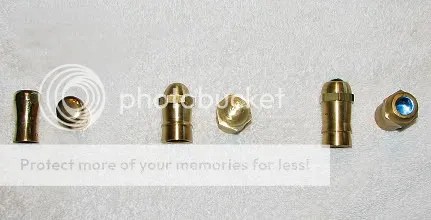
Horn knobs are simply pieces of brass that are drilled and tapped on the inside similar to a pipe cap.  They are applied to the tips of the horns to keep them blunt. Horn knobs are also quite attractive and give your cattle a distinctive look.  Horn knobs are not meant as any sort of protection from an aggressive animal.  They are not heavy enough to effect the horn’s growth and, if fitted properly, cause no pain to the animal.

Horns are made up of a bone core covered in a protective sheath.  The sheath is made of keratin,  the same material your hair and finger nails are made of.  At the tip of the horn the sheath forms a solid portion and this is the only area that the knobs effect.  Since there are no nerves in this material the knobs are completely painless.  Your cattle’s horns must have enough solid keratin before you can properly apply horn knobs.  Calf knobs require about a half-inch while larger knobs generally require at least a full inch.  This solid portion is usually indicated by a darker color all the way around the horn’s circumference.  If you are unsure it is better to wait and give the horn more time to develop.

First:

Secure the animal.  While applying the knobs is painless, it will tend to annoy the animal and they will need to hold still.  We prefer to tie the animal up but rather than trying to fully restrain their head with ropes or straps, we have a partner physically restrain the head by standing against their neck and pulling their neck around.  This along with frequent rest breaks seems to make the process a little better for them.

Second:

Mark the horn to show where the knob will fit.  Masking tape makes a good marker.   Also when laying it out a few things must be considered.  The knob will look its best and last the longest if it fits either flush with the horn or if the horn is slightly proud of the knob when finished.  The more length of horn you can leave inside the knob the more secure the knob will be.  In the case of fitting a close ended knob on a long slender horn it may be necessary to trim some of the length of the horn so that the knob doesn’t bottom out before it  fully seats.   You will need to eye-ball it so that the knob is straight when finished.

Third:

Using a pocket knife and file very carefully, carve and file the end of horn into a peg that will perfectly fit the knob.  Preferably this peg will have a 90 degree shoulder at its base.  This shoulder will be the natural size of the horn and again it is best if it is either the same diameter as the knob or slightly larger.  It is extremely important that you do not remove too much material at this point.  You can use a wrench to screw the knob on to check your progress.  If the peg is the proper size the knob will screw down the peg cutting its own threads into the horn.  If the knob doesn’t screw down the peg then the peg is likely to thick or too long if fitting a closed ended knob.  If the resulting threads are light or missing, then the peg is too small or out of round.  When  the knob will screw completely down and seat against the shoulder you carved, it is fitted.  Be careful not to strip the threads of the horn by over-tightening.

Fourth:

Once you are happy with the fit of the knob remove it one last time.  Apply a quality epoxy to the treads of both the horn and the knob and screw the knob back on.  Don’t be overly concerned about any excess epoxy that may leak out onto the horn.  The animal will quickly rub it off on its own.  If you fitted a closed-ended knob, then your task is now complete.  If you fitted an open-ended knob, then cut off the protruding tip of the horn and then your task is complete.


If you have done a proper job you should enjoy your new horn knobs for many years. Over time you will notice wear and tear on both the brass knob and the horn at the base of the knob.  Eventually, over several years, the horn at the base of the knob will be worn thinner and thinner untill the knob breaks off.  It is then time to start over with a new set of horn knobs.  How long they will last is unpredictable because cattle work their horns down at different rates.


The Brothers Four – The Ox Driver’s Song

Lyrics to Ox Driving Song :

Crack the whip and bring the blood
Make the leaders take the mud
We’ve got the wheels and we turn them around
One long hard pull and we’re on hard ground
To me rol to me rol to my rideo
To my rideo to my rudeo
To me rol to me rol to my rideoOn the fourteenth day of October-o
I hitched my team in order-o
To try the hills of Salado
To me rol to me rol to my rideo
To my rideo to my rudeo
To me rol to me rol to my rideo

When I got there the hills were steep
Would make another person weep
To hear me cuss
And crack my whip
And see the oxen pull and slip
To me rol to me rol to my rideo
To my rideo to my rudeo
To me rol to me rol to my rideo

When I get home among my friends
That’s where my toil and trouble ends
And bid adieu
To the whip and line
And ride no more in the winter time
To me rol to me rol to my rideo
To my rideo to my rudeo
To me rol to me rol to my rideo
To my rideo to my rudeo
to my rideo oo Yeah!

LAKIN’S PATENT OX YOKE

I find this yoke interesting.  It is a slider yoke that uses a different mechanism than most, but the adjustable staple is particularly interesting.

Ad taken from: Scientific American, Volume 10 1864

Improved Ox Yoke

Those who have witnessed the practical every day work on a farm must have been struck with the imperfect means by which oxen are usually attached to the yoke and how severely it taxes them at times not only by its weight but because of its rigid and unyielding nature. The usual pace of the ox is slow and stately and in his progress he naturally swings his ponderous head from side to side with even measure but with the ordinary ox yoke all this is denied him and he must literally bow to his yoke and bear its burden as best he may.  The consequences of this badly arranged ox yoke are that the beast is chafed and fretted by it that he works with much less willingness and gets wearied out sooner than he would if the yoke were adapted to his natural habits.  In the engraving herewith presented we have a yoke which is very different from the old-fashioned one and much better suited to the peculiarities previously alluded to. In addition to this consideration, it is very much lighter neater looking and it is believed altogether a great improvement.  In Fig 1 we have an elevation of this yoke in A is the yoke proper and B the bolster or saddle which spans the beast’s neck.  These bolsters slide back and forth on the yoke being connected in the manner shown in Fig 2.  By referring to this figure the reader will see that there are grooves C in the yoke and that the bolsters have projections D which fit in them; he may also see that there is a metallic bar E connected to the bolsters on the yoke; these bars are strongly fastened to the endless belt F which runs upon the rollers G.  It is easy to see as the bolsters are moved back and forth on the yoke the belt will run over the rollers and cause them to work evenly and easily as often as the oxen move their heads.  Uneven roads and the natural habits of the ox are thus accommodated and the result is a much greater amount of work with less fatigue to the cattle.  The bows H also pass through metallic bushes I and the yoke beam has slots J in it through which the bows move as the bolsters approach or recede from the center.  The eye bolt in the center is also fitted to a semicircular seat and the plate K has slots in it also so that it can slip from side to side.  This yoke is very strong and well made; it is correct in principle and we hope to see it generally substituted for those so long in use.  It was patented on the 4th of November 1862 through the Scientific American Patent Agency by TD Lakin and assigned to himself and Charles Wilder of Peterboro NH For further information address Charles Wilder as above.

Here is the actual patent for the yoke.

US36882

Pat is a Star!

Pat’s Commercial

Well I think he is the star of the commercial.  I don’t know where he found his motivation for his role but you can really feel his characters emotion!  I hope the fame doesn’t go to is head and he can keep himself grounded.  He doesn’t live with us on Ox Hill anymore but we can always say we knew him when.

Working Cattle in Early America


A few years ago an ox was defined as any bovine animal trained to work. In modern terminology an ox is a steer that has been trained to work and has reached maturity. The accepted age seems to be 4-years-old. The ox was probably the first wild animal that was trained to serve man as a draft animal. A cow likely was used, due to the ease in handling her as opposed to handling a bull.

When the pilgrims came to America in 1620 the only draft animals they had were themselves and their families. In 1623 the pilgrims at Plymouth sent Edward Winslow back to England for supplies. When he returned to Plymouth in 1624 he brought with him three Devon heifers and a Devon bull. To this day the descendants of these cattle, called Milking Devons, still make the best all-around farm oxen.

A working cow is the most efficient working animal available to man. She will do her share of the work, furnish your family with milk and beef and then replace herself. She will grow to only about 75% the size of an ox of the same breeding.

Ezra Meeker, who traveled the Oregon Trail in 1852, stated “On the plains in 1852, fully half of the teams were cows.” The immigrants took many cows with them across and a high percentage of them were not herded behind the wagon but yoked to the front of it.

Shoes were not usually needed on the ox that pulled the immigrant wagon or worked the early farm, as those animals were light in weight. As the ox of later years became larger and worked harder, wearing shoes became more important.

In the middle 1800s the three major freight lines alone were buying in excess of 150,000 head of steers each year for oxen. They would buy only 4- and 5-year-old steers, hence a steer had to be 4-years-old to be an ox.

The main reason ox teams were so popular on the freight lines in the middle 19th century was that they could pull freight for about half the cost of horse or mule teams. The American Indian also had much less tendency to steal an ox than a horse.

The preferred team on the freight lines was a pair of Texas Longhorns for leaders because they were aggressive enough that they would go almost anywhere. The teamster then wanted a big pair of Durhams for wheelers to handle the wagon tongue and to help stop the Longhorns when they tried to run away. The three pairs in between the Longhorns and the Durhams could be just about any breed. Work in this position is where a great many of the freight oxen got any and all of the training they received.

When you are trying to decide what breed to raise for working cattle you must take into consideration a great number of things. The most important things are what you will use them for, size, and cost. If you are planning to try competitive pulling in the unlimited class you need a Chianina or Chianina cross. If you just want a pair of steers to play with, Dexters will probably suit your needs just fine. If you want an animal to work a garden, a couple of acres, you need a good working cow or a pair of working cows.

You have surely heard the term “dumb as an ox.” The only way an ox is dumb is that the animal can’t talk. The reason some people think an ox is dumb is because these people are not capable of communicating with the ox. My father always told me, “There are far and away more balky drivers than there are balky draft animals.” A properly handled ox will do his best to please his handler. A good, patient and communicative teamster can make a poor ox look better. Conversely, a poor teamster can make even the best ox look bad.

Howard VanOrd

Don’t Cut Corners


When I first start working calves, my gee and haw turns are all sharp 90 degree turns.  Also, I think it is beneficial to stop the calf immediately before and after the turn.  This makes it easier for them to distinguish the commands and understand what you want them to do.  Never let the calf influence your path by pulling or crowding you.  Pick a line and stay with it.  That is one of many ways that cattle try to train the teamster.  Set goals when you are working.  For instance don’t be happy to just wander the yard.  Pick a precise route and follow it.  Pick ahead of time the places you will turn and stop and keep to your plan.  Later, when skidding logs or using a dump cart, do the same thing.  Don’t be happy to just dump a load in a general area.  Pick a particular spot and strive to place it exactly where you want it.  The more precision you expect the more you will get.

As The Pasture Turns: Introducing Betty and Ann

A few weeks ago we purchased two new American Milking Devon heifers from Ray Clark of Lyndonville Vermont.  We chose to buy from Ray because we wanted good stock and Ray’s herd is closely related to the heifers that where originally used to start Ox Hill Devons years ago.  Ray is a great guy and a wealth of Devon knowledge and lore.  His herd was in good condition and very clean, especially since it was January.  The heifers were born in May.  They ran with their mothers through the summer and had been tied in the barn since the onset of winter but hadn’t been handled.  While I would prefer to be able to start training them at a much younger age this was still a great starting point.  At this point, the heifers are in great health and condition.  They know what it is to be tied and while they are used to some human interaction no one has taught them any bad habits.  Ray was kind enough to have the heifers vaccinated for shipping fever and they made the nearly 600 mile trip home without incident.

The first night they where given a large box stall to themselves to settle in.  For the following two days we shut them and the rest of the herd in the barnyard.  This allowed them to become familiar with the electric fence and the rest of the current herd including Pat a large ten-year old Devon ox, a young Lineback heifer, and two young Holstein steers.  The moment that Betty stepped into the barnyard she immediately singled out the largest of the young cattle and pushed him the length of the barnyard.  She tried to challenge the other two but neither stood up to her and she immediately became number two in the pecking order.  Ann has asserted herself into the number three position simply by riding on Betty’s coat tails.  Pat the large ox was sold just the other night so Betty is now Queen of the pasture.

Betty and Ann are brought in twice a day and given a small treat of grain while tied with a narrow twine neck collar.  They are brushed and introduced to such things as having their legs and udders handled, “put in” and “stand over” commands, our dogs, and my twenty month old daughter.  I also use this time to take them out one at a time.  I take them for a short walk and focus on teaching them “come along” and “whoa” but I do use “gee” and “haw” when it is appropriate.  I drive them from the very beginning and don’t worry about halter breaking since they will be driven for now on anyway.  They have a narrow twine collar and a heavy metal bow over their neck to get them used to a yoke.  I try to end the walk on a positive note and make absolutely positive that the walk doesn’t end with any shenanigans. 

Betty and Ann have very different personalities.  They are both very alert but Betty is a very type A personality.  She is very sure of herself, always holds her head high and is more active.  Ann is more submissive, hangs her head in disgust, acts out more and is less active.  They also learn very differently.  Betty shows clear improvement nearly every time I take her out.  Ann is more frustrating because she seems to show little signs of improvement for several outings but suddenly she will show that she has indeed been paying attention all along and has developed just as well as Betty.  They are both quality animals that are very teachable but they have very different personalities.

Tune in next time for more As the Pasture Turns.